The Difference Between Stick-Built, Modular, and Prefab Homes
Choosing how your home will be built sets the tone for everything that follows: budget, schedule, finishes, financing, inspections, even how the house feels to live in. You’ll hear people toss around stick-built, modular, and prefab as if they’re interchangeable, but they describe distinct ways of getting from plans on paper to walls you can touch. The distinctions matter because each method carries different implications for cost control, timeline reliability, design freedom, and resale value. If you’re mapping out a build for the first time—or weighing a switch from traditional construction to factory-built components—understanding these differences will help you make confident decisions and avoid expensive detours.
At a high level, a stick-built home is assembled piece by piece on your lot by local trades. A modular home is constructed in large, finished sections in a factory, then transported and set on a permanent foundation. Prefab (short for prefabricated) is the umbrella that includes modular but also panelized systems and manufactured homes built to the federal HUD Code. Once you know who sets the rules (local building codes versus HUD), what gets built off-site (modules, panels, or entire units), and how the pieces come together on your land, the trade-offs become clear—and you can align the method with your budget, site constraints, and design goals.
This guide walks you through how each method actually works in the field, where the money and risk concentrate, how lenders and appraisers see these homes, and the practical realities—transport permits, cranes, weather, and change orders—that shape the experience. By the end, you’ll have a simple framework to choose the right path for your build and a realistic sense of what to expect.
Definitions at a Glance
A stick-built home is constructed entirely on-site. Crews frame walls from dimensional lumber, set trusses or rafters, install mechanicals, and complete finishes in the open air. This is the default method most buyers picture and the baseline for local International Residential Code (IRC) compliance, permitting, inspections, and financing.
A modular home is built to the same local codes as stick-built housing but fabricated indoors as fully framed, insulated modules complete with mechanical rough-ins, windows, and interior drywall. Those modules travel by truck to your lot, a crane sets them on a permanent foundation, and local trades “button up” the seams, finishes, and site work. Properly executed, modular homes are indistinguishable from stick-built to the untrained eye.
Prefab is a broader category. It includes modular, panelized (factory-built wall/floor/roof panels that are assembled on-site), and manufactured homes (constructed on a steel chassis to HUD standards, then delivered as one or more sections). Panelized systems still rely on significant on-site assembly; manufactured homes are the most factory-complete, but they follow a different regulatory path and financing landscape.
How Each Method Is Built, Step by Step
Stick-Built: Field-Driven and Flexible
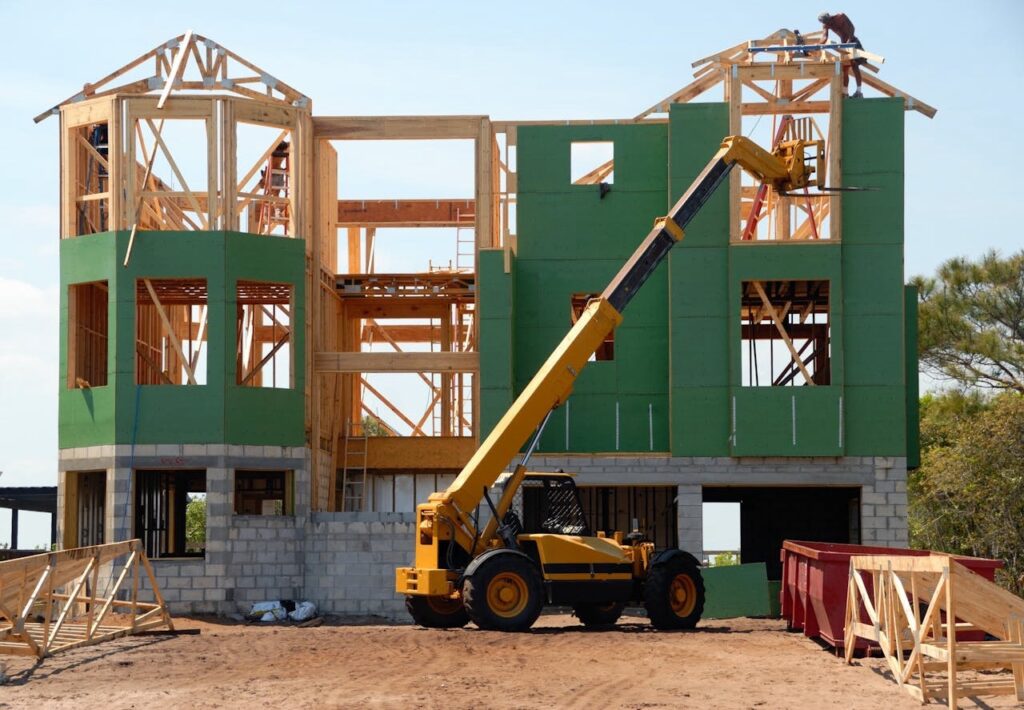
A stick-built project starts as soon as the foundation crew leaves and the lumber package arrives. Carpenters frame first-floor walls, platform the second floor, raise the roof, and sheath the exterior. Electricians, plumbers, and HVAC techs weave systems through studs; inspectors sign off at each stage. Exterior cladding and roofing proceed in parallel with interior insulation, drywall, and finishes. Everything is sequenced around weather, material deliveries, and the availability of trades.
Because every decision lives on the job site, flexibility is the hallmark. If you decide to widen a window, bump a wall, or adjust stair geometry, your builder can price the change and implement it. That freedom is also the risk: change orders add cost and time, and inclement weather slows progress. In many markets, field labor is scarce, which can stretch schedules and push budgets beyond the original estimate.
The upside is absolute design control and excellent fit to complex lots. Steep slopes, tight urban infill parcels, or access-challenged rural sites that would complicate module delivery are often easier with stick-built sequencing. You’re trading speed and predictability for adaptability and craft.
Modular: Factory Precision, On-Site Assembly
Modular builders fabricate your home in controlled conditions. Walls are square, insulation is consistent, and materials stay dry. Quality checks occur at every workstation, and the production calendar isn’t derailed by rain or freeze. Meanwhile, your site work proceeds—foundation, utilities, driveway—so when the modules arrive, a crane “stacks and sets” the home in a day or two.
After setting, crews seal module seams, complete roof connections, install mechanical tie-ins, and finish flooring and trim at the mate lines. Because so much is done in the factory, the on-site phase is short. This telescopes the overall timeline and reduces carrying costs such as construction loan interest and interim housing.
Modular’s constraint is structural and catalog-driven. Modules must transport safely and meet highway size limits, so some spans, angles, and cantilevers are harder to achieve. Many manufacturers offer custom options, but deep structural changes can be impractical. If your design goals align with the system, you get repeatable quality and speed without sacrificing local Code Compliance or long-term value.
Prefab Variants: Panelized and Manufactured
Panelized systems ship factory-built wall panels, roof trusses, and floor cassettes to your lot. Think of it as a kit with exacting tolerances: framing goes up in days, not weeks, which shortens exposure to weather and improves shell quality. You still perform the bulk of mechanicals and finishes on-site, so the schedule improvement sits between stick-built and modular.
Manufactured homes are built to the HUD Code and often delivered on a steel chassis. They are typically the fastest to occupy and the least expensive per square foot. When placed on a permanent foundation with proper skirting and utility connections, they can provide durable housing at a price point many buyers can reach. The trade-offs are regulatory and financial: lenders and appraisers treat HUD-code homes differently than local-code homes, and in many markets they appreciate more slowly unless land ownership and permanent foundations are clear.
Cost, Time, and Risk: Where the Money Really Goes
Construction costs aren’t just about line items for framing and finishes; they’re the sum of labor efficiency, weather exposure, change management, and logistics. Stick-built projects carry the most schedule uncertainty because the job site is exposed to climate, and trades must sequence around other projects. Material waste can be higher, and rework from weather or inconsistent crews adds expense. That said, competitive bidding among local subs and the ability to value-engineer on the fly can keep a nimble stick-built project in check—if the builder runs a tight ship and you limit midstream changes.
Modular packages often look pricier at a glance because you see a large factory invoice early, but the total project cost frequently lands lower. Indoor production reduces waste, labor time per square foot is predictable, and the on-site period is compressed. You also limit cost creep from extended rentals, site security, and repeated mobilization. The primary risk bucket is logistics: crane time, set crew coordination, and transport permits. With experienced teams, those are known quantities.
Panelized construction moves the framing savings needle but leaves more variability than modular because mechanicals, insulation choices, and interior finishes progress on-site. Manufactured homes win on upfront cost and speed, but if you’re financing land separately or contemplating future appreciation, make sure you understand how your market treats HUD-code housing versus local-code homes.
Codes, Inspections, and Appraisals
Building Codes and Oversight
Stick-built and modular homes follow the same local codes (for most U.S. projects, that’s the IRC plus state and municipal amendments). Modular factories undergo third-party inspections, and modules arrive with certification labels; local inspectors then review the foundation, utility connections, and final assembly. This dual oversight can actually raise the quality floor compared with entirely field-built work.
Manufactured homes follow the federal HUD Code, which standardizes construction and energy requirements across states but sits outside your city’s IRC path. That distinction affects everything from setback rules to additions and porches. If you’re thinking of future expansions, ask your building department how they handle hybrid projects and ancillary structures.
Appraisals and Lending
Appraisers compare apples to apples. Modular homes appraise like stick-built because they meet the same codes and look the same once finished. Manufactured homes are appraised within their own category, often with different depreciation curves. For mortgages, conventional, FHA, VA, and USDA programs are widely available for stick-built and modular; manufactured financing exists but may carry tighter criteria and different terms. If your plan involves a construction-to-permanent loan, modular’s shorter timeline can lower interest paid during the build.
Insurance and Warranties
Insurers evaluate risk and replacement cost. Many carriers treat modular and stick-built similarly, especially after the Certificate Of Occupancy is issued. Manufactured policies exist but can differ in coverage types and premiums. On the warranty side, modular factories typically include a structural and systems warranty layered over local builder warranties, while stick-built coverage depends on your builder and state law.
Design Flexibility and Architectural Control
Stick-Built: Unlimited Moves, Unlimited Temptation
With a stick-built path, architects and builders can shape almost any geometry your engineering and budget can support—angled walls, vaulted ceilings, deep cantilevers, site-specific glazing, or unusual stair runs. That freedom is intoxicating, but it invites scope creep. The discipline is to lock your drawings before lumber hits the site, document every decision, and resist “just one more tweak” after framing starts.
Modular: Freedom Within a System
Modern modular catalogs cover most popular styles—farmhouse, modern, craftsman, coastal—with flexible kitchen, bath, and bedroom layouts. Within module size limits, you can push ceiling heights, mix dormers and shed roofs, and upgrade finishes. If your vision relies on a single 40-foot clear span or an eccentric angle that won’t travel, modular may force compromises. The smartest approach is to design with a modular manufacturer from day one so your architect plays to the system’s strengths.
Panelized and Manufactured: Practical Choices
Panelized projects offer architectural freedom closer to stick-built because you’re assembling panels rather than transporting finished rooms. Manufactured homes have improved dramatically in plan variety and finishes, but structural customization remains limited. If high design fidelity is nonnegotiable, confirm early whether a prefab provider can truly execute the details you care about—window proportions, eave depths, siding reveals, and stair craftsmanship.
Energy Efficiency, Durability, and Quality Control
Factory Precision and Dry Materials
One of the quiet advantages of modular and panelized construction is that framing and insulation happen in a dry, controlled environment. Air sealing is more consistent, cavities are insulated before weather exposure, and materials arrive to your site protected. Tighter envelopes mean lower heating and cooling loads, quieter interiors, and better long-term performance with fewer callbacks for seasonal movement.
Site-Built Craftsmanship and Variability
A skilled stick-framing crew can produce equally excellent results, but quality is more variable because it depends on the specific trades on your job and the weather window they get. If you go stick-built, insist on blower-door targets, continuous exterior insulation where climate-appropriate, and documented air-sealing details. Ask for submittals on SIPs (structural insulated panels) or exterior foam strategies if you’re chasing high-performance goals.
Materials and Moisture
Moisture is the silent enemy of durability. Factory-built components that stay dry until enclosure give you a head start. For stick-built projects, temporary roofing and prompt window installation shorten the period when framing gets wet. In any method, specify vapor-open WRBs, proper flashing, and ventilated cladding assemblies to reduce risk of trapped moisture.
Land, Site Access, and Logistics
Reading the Lot
Your parcel can decide the method before you do. Narrow urban alleys, sharp switchbacks, low wires, or weight-limited bridges complicate module delivery and crane placement. A stick-built crew with a boom truck might slip where a 70-ton crane cannot. Conversely, a flat, wide rural lot near a highway is modular paradise.
Cranes, Permits, and Staging
Modular set days are choreography: police details for temporary road closures, flaggers, oversize-load permits, and precise crane staging. The cost is predictable, but you must plan early. Panelized packages need less heavy equipment but still require clear staging areas. Stick-built spreads mobilization across months instead of days, which can ease logistics but prolong neighborhood disruption.
Utilities and Foundations
All methods need a foundation, utilities, and site drainage dialed in. Modular and manufactured homes require exact foundation dimensions and anchored connection points. If you’re eyeing a basement, both stick-built and modular handle it well; manufactured homes may require specific foundation systems and skirt details to satisfy local rules and lender requirements.
Resale Value and Market Perception
Stick-Built: Familiarity Sells
Buyers, agents, and appraisers know what they’re seeing with stick-built homes. Assuming quality construction and good maintenance, the market receives them without hesitation. In neighborhoods with strict architectural review, stick-built often navigates approvals more smoothly because it can mimic historical details closely.
Modular: Equal on Paper, Educate in Practice
Properly executed modular homes appraise and sell like their stick-built neighbors. The only friction comes from misconceptions. Savvy listing agents highlight factory QA, energy performance, and recent code compliance to reframe the narrative from “prefab” to “precision-built.” In areas familiar with modular, there’s no discount—and sometimes a premium for newer, energy-efficient homes.
Manufactured and Panelized: Category Matters
Manufactured homes remain a distinct segment. Land ownership, permanent foundations, and local attitudes shape resale outcomes. Panelized homes resell like stick-built because they are, in effect, stick-built with a head start. When documentation is clean—permits, inspections, manuals, and warranties—buyers feel confident regardless of how the shell was framed.
When Each Option Shines
If your top priority is architectural freedom on a tricky site, stick-built keeps every lever in reach. If your priority is predictable schedule and cost control with strong energy performance, modular is hard to beat. If you need speed and entry-level pricing, manufactured housing provides a path that traditional construction cannot match. Panelized sits in the middle—faster framing without the full logistics stack of modular—ideal for regions with wet seasons where drying-in quickly protects your investment.
Hidden Costs and Avoidable Mistakes
The biggest cost overruns rarely come from a single upgrade; they come from sliding decisions. Late electrical changes mean drywall fixes; revised window sizes cascade into siding, flashing, and trim. Whichever method you choose, lock your drawings, finishes, and fixture schedules before ordering. In modular, finalizing specifications early is essential because factory lines move fast. In stick-built, demand a transparent change-order process with pricing and schedule impact documented before work proceeds.
Don’t forget the soft costs: surveys, soils testing, energy modeling, structural engineering, permit fees, utility tap fees, impact fees, and third-party inspections. Faster methods reduce carrying costs—construction loan interest and temporary housing—but you still need a cushion for surprises like rock excavation, utility relocation, or upgraded stormwater management after a municipal review.
A Simple Decision Framework
Budget and Finance Fit
If you need hard guardrails on total spend, modular’s predictability can be your ally. You see a large portion of cost early and compress the time you’re paying interest. If you have room for iteration and want bespoke detail, stick-built unlocks that at the expense of certainty.
Site and Access Reality
Walk the delivery route with your builder or modular rep. Measure clearances, check bridge load limits, and locate crane pads. If access is tight, stick-built or panelized may be the practical choice even if modular pricing looks attractive on paper.
Design Priorities
List the nonnegotiables—ceiling heights, window groupings, stair form, kitchen layout—and pressure-test them against modular catalogs and module dimensions. If the essentials fit, you’ll get speed and quality. If they don’t, force-fitting the design only leads to frustration.
Timeline and Risk Tolerance
If you must be in by a specific date—school year, lease end, rate lock—factory-built methods reduce weather surprises. If your schedule is elastic and you thrive on hands-on iteration, the longer arc of stick-built may suit you.
Team and Experience
Choose experience over theory. A modular project run by a seasoned set crew will outperform a first-timer’s stick-built job—and vice versa. Ask for addresses, speak with past clients, and verify that your lender and appraiser understand the chosen method.
Frequently Asked Questions
Are modular homes cheaper than stick-built?
Often, yes—total project costs for modular can land about 10–20% lower once you account for reduced labor hours, minimized waste, and shorter carrying costs. The savings vary by region, design complexity, and finish level. If you spec luxury cabinetry, stone everywhere, and high-end mechanicals, modular won’t magically make that cheap; it will just build it more efficiently.
Do modular and panelized homes last as long as traditional homes?
They do when built and maintained properly. Factory conditions reduce moisture exposure, which helps longevity. Long-term durability comes down to envelope detailing, proper flashing, sensible ventilation, and homeowner maintenance—exactly the same fundamentals that govern stick-built performance.
Can I get a standard mortgage for modular?
Yes. Because modular homes meet local codes, they qualify for conventional, FHA, VA, and USDA loans, and they appraise against local-code comparables. Manufactured homes follow different underwriting rules; financing is available but under different programs and criteria.
Will a modular home hurt resale value?
In most markets, no. Once finished, modular homes sell like stick-built of similar age, size, and quality. If there’s lingering skepticism locally, a good listing package—factory specs, energy data, and inspection records—helps buyers focus on quality rather than labels.
What’s the difference between prefab and modular?
Prefab means “built before it gets to your site.” Modular is one type of prefab. Other types include panelized (walls, floors, roofs shipped as panels) and manufactured (built to HUD standards, often on a steel chassis). The key distinctions are the code you build to and how complete the home is before it arrives.
Can I customize a modular home?
Absolutely, within the constraints of module sizes and factory processes. You can select elevations, room layouts, finishes, and performance upgrades. If your vision hinges on structural moves that won’t travel or fit line equipment, consider panelized or stick-built for that specific design.
Are manufactured homes a bad investment?
They’re a different investment. Upfront costs are lower and timelines are shorter, which can be life-changing for affordability. Appreciation patterns differ by market, land ownership, and foundation type. If appreciation is a major goal, talk to a local agent who knows how HUD-code homes perform in your area and ensure the home sits on a permanent foundation on land you own.
How fast can I move in with each method?
Manufactured homes can be ready in weeks once the site is prepared. Modular projects commonly finish in three to six months because the factory and site work run in parallel. Stick-built often spans six to twelve months or more, depending on weather, labor availability, and complexity.
Final Takeaway
There isn’t a single “best” way to build—there’s a best fit for your budget, your site, your timeline, and your design ambitions. Stick-built maximizes artistry and on-site flexibility, modular maximizes schedule reliability and factory precision while keeping local-code equivalence, and prefab broadly—especially panelized and manufactured—offers speed at a range of price points with distinct regulatory paths. Decide what you can’t compromise, map those priorities onto the realities of your lot and financing, and choose the path that gets you a dry, tight, well-detailed home with the least drama. With the right team and clear decisions upfront, any of these methods can deliver a house you’re proud to live in—and a build process you’re relieved to be done with.